Last month, Toronto celebrated Black History Month with a huge variety of events. From art exhibitions like “143 (I Love You)” put together by eight Toronto-based Black artists, to the Toronto Black Film Festival, the city celebrated and showcased the works of hundreds of Black people and sparked a conversation about the human rights struggles faced by Black People in Toronto. Although the month is now past us, I feel it important to highlight one fairly recent and overlooked issue facing Black people in Toronto: Carding.
The official term has varied over the years, but Carding or “street checks” refer to the police practice of stopping, questioning, and recording the details of individuals who hadn’t committed any particular offence. According to an article in the Globe and Mail, “Innocent people who exercised their right not to co-operate often found themselves on the ground with a police officer’s knee across the back of their neck.”
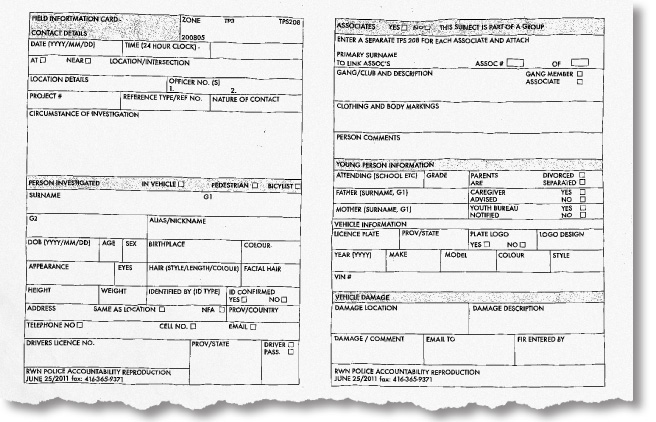
This practice was brought to my attention by an article in Toronto Life, where black journalist Desmond Cole recounts some of the 50 or so times he has been interrogated by the police in Kingston and Toronto.

In Toronto, I thought I could escape bigotry and profiling, and just blend into the crowd. By then, I had been stopped, questioned and followed by the police so many times I began to expect it. In Toronto, I saw diversity in the streets, in shops, on public transit. The idea that I might be singled out because of my race seemed ludicrous. My illusions were shattered immediately.
– Desmond Cole, Toronto Life
Carding was put under the spotlight in 2010, when The Toronto Star gained access to and analyzed police data to report that Black people were more likely to be carded than White people in all of the city’s patrol zones, and increasingly so in White-dominated neighbourhoods. In addition, the Globe and Mail reported that “Between 2009 and 2011, Toronto Police entered 1.1 million names in its carding database – roughly one entry for every three Torontonians.” In response, the The Toronto Police Services Board established a committee which met from July 2012 to November 2013 to discuss Toronto’s carding policies.

Starting January 1st 2017, a new rule was put into effect banning the random checking of individuals and the collecting of their information. Race is prohibited from being a part of the reason for collecting any information about a person, and the public must be informed that they have the right to refuse to talk and that their lack of cooperation cannot be held against them. However, the police can still ask for information during traffic stops, when someone is being detained, or when a search warrant is issued. All interactions between the public and the police must be recorded and a random sample of these records will be analyzed periodically to ensure compliance with the new regulations.
This regulation is definitely a step in the direction, but it could be improved. I believe compliance with the regulations could be measured in a more effective way than by analyzing data recorded by the police officers themselves. Additionally, some aspects of the regulation are a bit ambiguous, as police officers could still get information if they “reasonably suspects [an offence] has been or will be committed (CBC).” It should be made clearer what counts as suspicious and what doesn’t, as this vagueness could be exploited.
While this regulation could help reduce targeted carding, it does not address the underlying issue: prejudice against Black people. City officials must acknowledge the damage that has been done through the decades of discriminatory street checks, and find a way to change the stereotyped mindsets of the police department and all Torontonians. The following statement by Desmond Cole is just one example of the immense harm inflicted upon the Black community by practices such as carding:
On a good day, I like the way I look. At other times, particularly when people point out how dark I am, I want to slip through a crack in the ground and disappear. When I walk down the street, I find myself imagining that strangers view me with suspicion and fear.
In Kingston, I was used to women crossing the street when they saw me approaching, but until I moved to Toronto, I’d never seen them run. One night, I stepped off a bus on Dufferin Street at the same time as a young woman in her 20s. She took a couple of steps, looked over her shoulder at me, and tore into a full sprint. I resisted the urge to call out in my own defence.
– Desmond Cole, Toronto Life
I believe Carding should be a reminder to all that while Toronto is a city which tolerates and celebrates diversity more than most others, it still has a long way to go before it eliminates institutional and social discrimination against minority groups. It should be used to shine a light on the overrepresentation of Black people in prisons and police interactions. As stated in the Toronto Life article mentioned earlier, “[Black people] account for 9.3 % of Canadian prisoners, even though [they] only make up 2.9 % of the populace at large.” Additionally, as mentioned on Global News, 25 % of the Special Investigation Unit cases were about Black People even though they’re only 8.8 % of Toronto’s Population.
It’s important to educate people about issues like Carding to help the public understand that there are still unjust institutions present in Toronto today. Otherwise, we may get trapped in a vicious cycle where people are subconsciously and unfairly afraid of Black people due to their apparent overrepresentation in the criminal justice system, even though this is only due to the improper actions of the police.
Sources Used:
“Little to no proof police carding has effect on crime or arrests: Ontario report” CBC Dec 31 2018
“A year after Ontario moved to restrict carding, has anything changed?” CBC Mar 07 2018
“Ontario regulation bans random carding by police” CBC Mar 22 2016
“‘Random carding should end’: Ontario Justice Tulloch” City News Jan 4 2019
“Here’s what you need to know about Carding” CBC TV
“The Skin I’m In: I’ve been interrogated by police more than 50 times—all because I’m black” Toronto Life Apr 21 2015
“New Ontario rule banning carding by police takes effect” CBC Jan 01 2017
“Black people grossly overrepresented in cases where Toronto police use force: report” Global News Dec 10 2018
“Toronto Police have ended carding, report indicates: Only one ‘regulated interaction’ was recorded in 2018, though long-time critics say that the data don’t tell the full story” The Globe and Mail Nov 15 2019
“It’s time to end carding once and for all” The Globe and Mail Jan 04 2019
“Known to police: Toronto police stop and document black and brown people far more than whites” The Toronto Star Mar 09 2012
 g l a s s m a z e . c o